There is a pattern that repeats itself across transformation programmes with surprising consistency.
The scope is carefully defined. The budget is agreed and approved. The timeline is planned in detail. The technical solution is selected, procured and implemented. And then, somewhere around go-live, someone asks the question that should have been asked at the beginning: how will we actually know if this worked?
Too often, nobody is quite sure.
The Imbalance That Costs Programmes Their Value
Most transformation programmes invest significant effort in defining what will be delivered. Far less attention goes to defining what will be different, in measurable business terms, once the delivery is complete.
This imbalance has a predictable consequence. Programmes are delivered on time and within budget, then closed. Six months later the organisation still cannot point to clear improvement in performance, customer experience, cost or revenue. The technology went live. The transformation did not fully materialise.
Being on time and on budget is not the same as delivering value. It never has been.
Why Benefits Realisation Cannot Wait Until the End
The most common mistake is treating benefits realisation as a post-implementation exercise, something to be addressed once the technical work is done. By that point, it is almost always too late to do it well.
Benefit owners were never identified. Baselines were never taken. Original assumptions have drifted with changing scope and priorities. By the time anyone evaluates what was achieved, the original momentum is long gone.
Benefits realisation that begins at go-live is not benefits realisation. It is retrospective justification.
What Good Looks Like
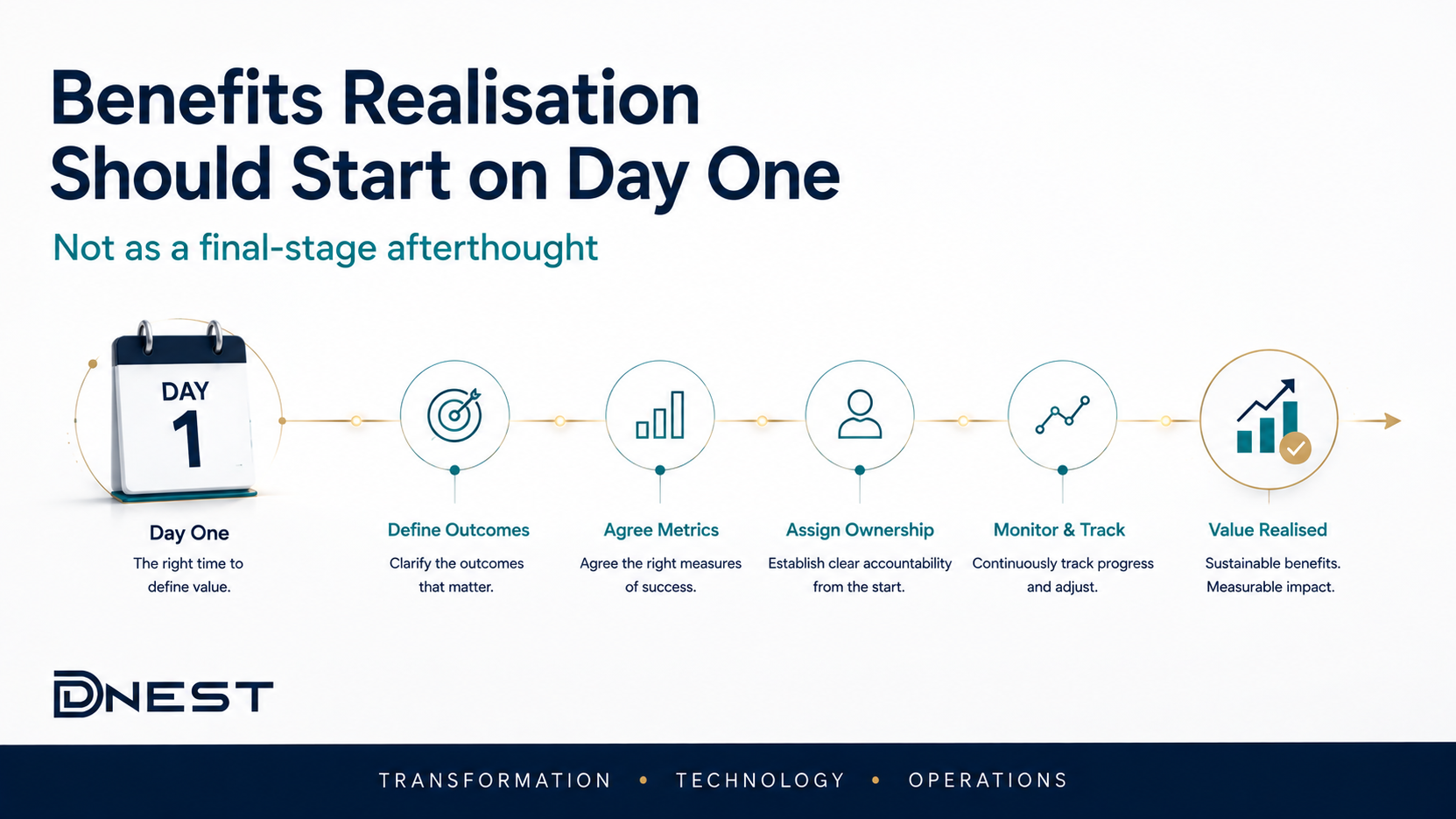
The programmes that consistently deliver value treat benefits realisation as a discipline that runs in parallel with delivery from day one, not as an appendix to it.
That means starting with a clear answer to four questions before a single workstream begins. What specific improvements is this programme intended to deliver? How will those improvements be measured? Who is personally accountable for realising each one? And when are they expected to materialise?
From those answers a benefits framework can be built, one that sets baselines before change begins, defines success in business terms, assigns named ownership, and tracks progress throughout rather than waiting until go-live.
The framework does not need to be complex. It needs to be honest, specific and consistently maintained.
The Discipline That Separates Good Programmes From Great Ones
I have worked on programmes where benefits tracking was a governance formality, a slide that stayed green because nobody updated it. And I have worked on programmes where it was a live weekly discipline that shaped prioritisation and kept leadership focused on outcomes rather than activity.
The difference in the quality of the final result was significant.
Organisations that treat benefits realisation as a core discipline, not an afterthought, are consistently better positioned to achieve the value they set out to create. They make better decisions during delivery because they are always asking whether what they are doing is moving them toward the outcome. And they are far less likely to find themselves, at programme close, unable to articulate what actually improved.
Final Thought
Transformation is not an exercise in delivering outputs. It is an exercise in improving the organisation.
The outputs matter (scope, timeline, budget) but only as means to an end. The end is measurable, lasting business value. And the only way to reliably get there is to define what that value looks like, assign someone to own it, and track it from the very first day.
At Dnest, we help organisations stop treating benefits as an afterthought and start treating them as a core discipline from day one. If your programmes are delivering activity but not clear value, let’s talk.